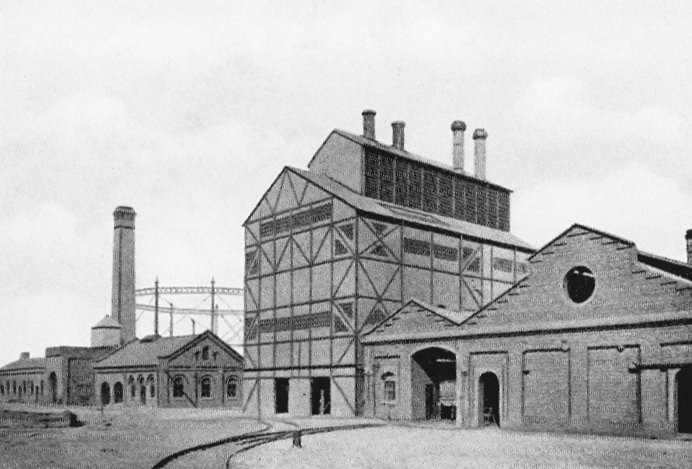
Tipton Gas Works Tipton's first gasworks officially opened on Saturday the 1st July, 1882. It stood on a site that had been purchased from the Tipton Green Colliery Company by the Local Board. Its location was between the Stour Valley Railway and Workhouse Lane (now called Alexandra Road), about 200 metres from Tipton Railway Station. There were sidings from the railway and a canal basin so that coal could easily be transported there. The gas works produced town gas by heating coal in retorts. For many years Glover West vertical retorts were used, until 1954 when they were replaced by a Woodall Duckham vertical retort plant, which operated until 1960. 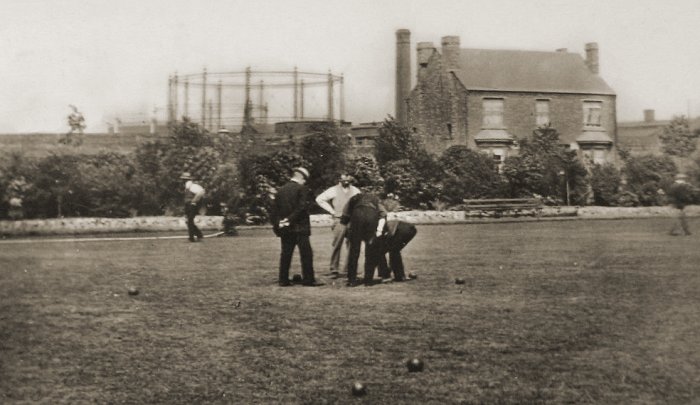 Coal was delivered to the stockyard by rail where it was tipped from wagons by a rotary tippler and dropped into a crushing machine before being piled into a heap, which was continuously monitored for temperature changes, due to the danger of spontaneous combustion. Coal was transferred to the retort house in one of two continuous bucket conveyors that carried it to the coal storage bunkers from where it passed through a gas-tight valve into a much smaller hopper, which opened directly into a retort. In the retort it was heated up to 1300 C and the gas given off was removed through pipes for purification. Eventually the coal was turned into red hot coke that was quenched by a steam jet. The coke was dropped into one of two longitudinal conveyors and transported to the screening plant where it was graded into sizes and stored in large bunkers, before being sold. 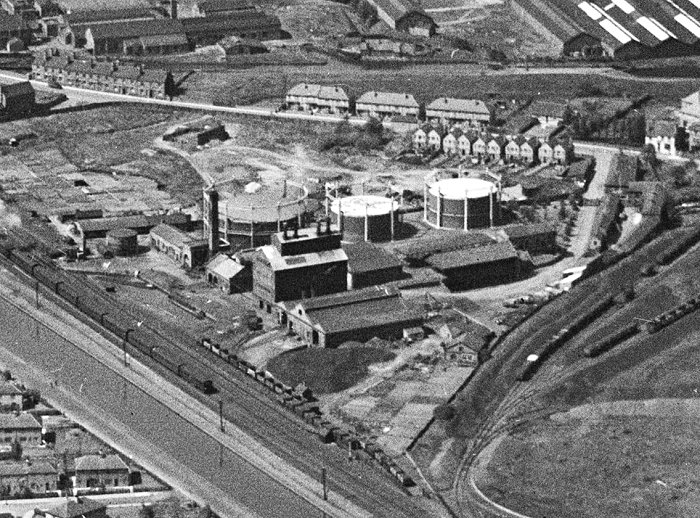 Impure coal gas was taken from a retort through a cast-iron off-take pipe where any solids were removed. The hot gas then passed through the primary condenser where the bulk of the tar and some of the ammonia were removed to leave partially clean gas. This then passed into a large cast-iron ammonia scrubber where layers of wooden grids, sprayed with softened water, created a large wet surface that readily dissolved any ammonia in the gas. The gas continued its journey by passing through secondary condensers that removed any remaining ammonia before passing through layers of iron-oxide to remove hydrogen sulphide. The gas was now sufficiently pure and passed through a gas meter before being stored in one of Tipton's four gasholders. The by-products from the manufacturing process were all sold, including tar, ammonia, coke, and sulphur. The tar was pumped into a storage tank before being delivered to Midland Tar Distillers by canal boat. The Mond Gas Works To the east of Tipton Gas Works was a site occupied by the South Staffordshire Mond Gas Company that produced Mond gas for power and heating purposes. The gas was supplied to a large area stretching from the edge of Birmingham to the boundary of Wolverhampton, and as far as Pelsall and Stourbridge. It was formed by an Act of Parliament in 1901 to make and distribute producer gas across an area of 123 square miles. Mond gas was a variant of producer gas in which coal was completely converted to ash, rather than to coke, as would happen in a retort. The site at Tipton was built in 1902, beside the Stour Valley Railway Line and the Dixon's Canal Branch, just to the east of Tipton's Gas Works. It was the largest example of a producer gas plant in the UK. 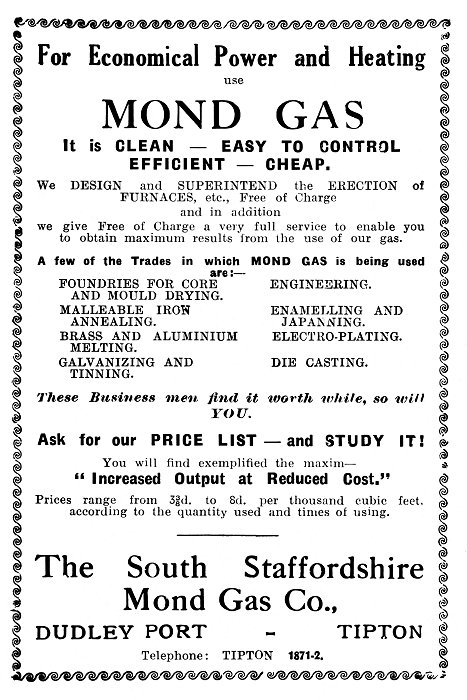 The plant had 32 producers, capable of handling over 600 tonnes of coal per day. Most of the plant, including the producers, the ammonia recovery, gas washing and cooling equipment were all duplicated to ensure a reliable supply.
The gas was compressed and distributed from the plant at a pressure of 10 pounds per square inch into asphalt-covered steel gas mains. This was the first example of a high-pressure gas network in the UK. Later the plant was fed from coke which resulted in gas with a lower calorific value. When this happened, gas from the plant had to be mixed with conventional coal gas from Tipton Gas Works, to enrich its calorific value. The Mond gas works closed in 1963. A report of the Institution of Mechanical Engineers visit to the South Staffordshire Mond Gas (Power and Heating) Company in 1910 The South Staffordshire Mond Gas (Power and Heating) Co. was formed by special Act of Parliament in 1901 to make and distribute gas for power and heating purposes over the area extending from the City of Birmingham boundary on the one hand to the Wolverhampton Borough boundary, and from Pelsall to Stourbridge on the other; an area of about 123 square miles, having a population of very nearly three-quarters of a million, and comprising the Boroughs of Dudley, Smethwick, Walsall, Wednesbury, West Bromwich, and Wolverhampton; the Townships of Amblecote, Bilston, Brierley Hill, Coseley, Darlaston, Heath Town, Lye and Wollescote, Oldbury, Quarry Bank, Rowley Regis, Sedgley, Short-Heath, Stourbridge, Tipton, Wednesfield, and Willenhall; and the Districts of Halesowen, Kingswinford, and Walsall (including Bentley). It is what may very aptly be termed the industrial heart of England. The site at Dudley Port, Tipton, covers an area of about 40 acres. The first section of the works was begun in 1902, and completed and gas made early in 1905. The plant comprises eight producers, each capable of gasifying 20 tons of fuel per day of 24 hours, and generating sufficient gas to drive gas-engines of 2,000 hp. continuously. The total capacity of the present section is thus equal to 16,000 h.p. The fuel is brought by boat into the canal basin, or by rail on to the siding, both of which have been specially constructed, and is unloaded by hand into bunkers; the entrance to these from the boats is a little above water-level, and at the ground-level from the trucks. 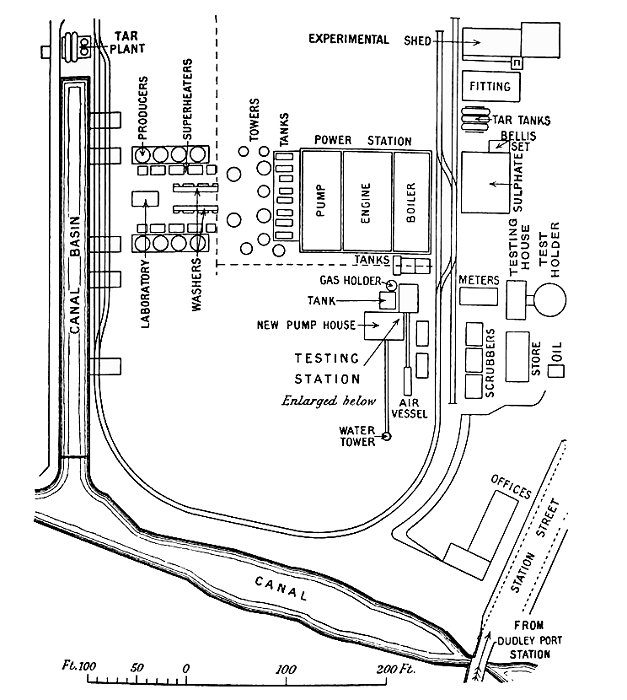 From these bunkers the fuel is automatically fed into two "Hunt" conveyers, each having a capacity of 40 tons per hour, and which convey and distribute the fuel into the storage bunkers over each set of producers. The bunker over each producer will hold 40 tons. The conveyers are driven electrically, the motors being about 5 hp.
The gas after leaving the producers--at about 550° C--is thoroughly washed in mechanical washers, and after passing through the ammonia recovery and gas-cooling towers, is further purified by large centrifugal fans (two of which are running in series at 850 revolutions and are driven by motors of 45 hp. each), and then passed through the scrubbers and the meters, before being compressed and sent through the mains for distribution. The air-blast for working the producers is produced by Roots' blowers (made by Thwaites Brothers), of which there are three, each of 50 hp. The Lee-Howl water-pumps can each pump 160 tons of water per hour. All the fans, washers, etc., are operated electrically, and the works, which are run constantly night and day, are also lighted by electricity, the current being generated by Westinghouse three-cylinder vertical gas-engines, each of 250 hp.; the voltage is 220. There are two of these engines, one only running at a time, the other being kept as a stand-by. 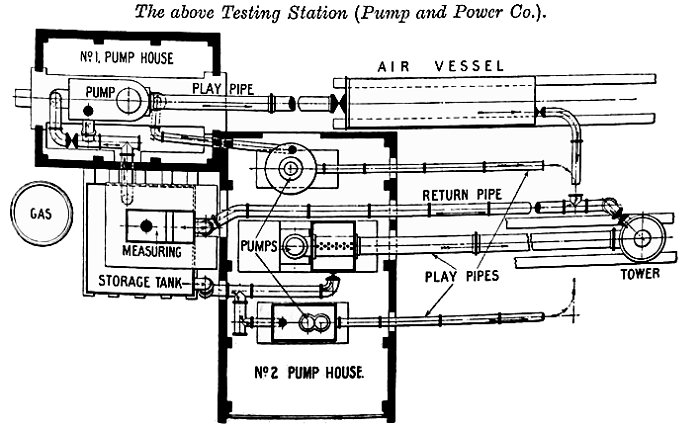 The three compressors (made by Fraser and Chalmers) are used for forcing the gas through the mains. Each compressor is of 450 hp., and will compress 500,000 cubic feet of gas per Lour. Large quantities of steam are required for working the plant, and this is provided by four Climax boilers each of 500 hp., capable of evaporating 1,500 gallons of water per hour, at a working pressure of 160 lb. per square inch. Sulphate of ammonia is recovered by evaporation in specially constructed stills, the crystallized sulphate being afterwards dried in hydro-extractors. The gas is measured by being passed through rotary meters, each capable of passing 500,000 cubic feet per hour.
Mains varying in size from 36 inches in diameter at the works to 21 inches at the end of the circuitor of the trunk main have been laid, and are filled with gas through Toll End, to Ocker Hill, where the main bifurcates, one leg passing through Bilston into Wolverhampton, the other leg passing through Leabrook and Wednesbury into Walsall. Gas is at present being distributed under a pressure of 5 lb. per square inch. This pressure is reduced on consumers' premises by means of reducing valves, which have been specially designed for the purpose, to the pressure suitable for each individual case. The trunk-mains are of the Ferguson locking-bar type. All other pipes (except specials) are made of wrought-iron, or steel, with screwed joints. The total length of trunk and branch-mains laid to end of 1909 was 251 miles. The gas is connected to over 100 works, and is used for all kinds of metallurgical and heating operations, as well as for generating power by means of gas-engines. |
