The Wheel of the Year
|
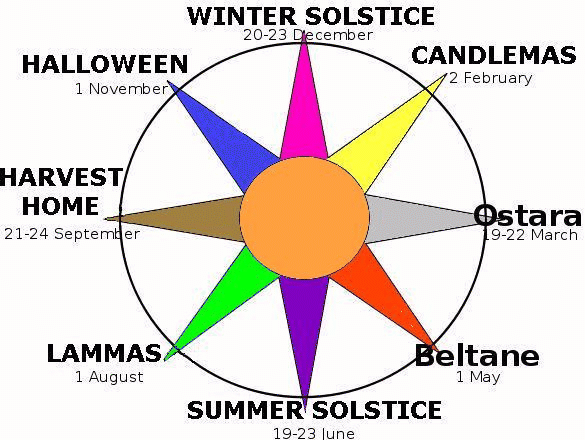
The Wheel of the Year consists of eight festivals, throughout the annual
cycle of the Earth's seasons.In many forms of Neopaganism, The passing
of time and natural processes are seen as following a continuous cycle
and are represented by a circle or wheel. The progression of birth, life,
decline and death, as experienced in human lives, is echoed in the
progression of the seasons. Wiccans also called Wicca are a Neopagan type
of religious group formed in the nineteen fifties, they also see this cycle
as echoing the life, death and rebirth of their Horned God and the fertility
of their Goddess.These festivals are referred to by Wiccans as Sabbats.
While most of these festivals names derive from historical Celtic and
Germanic , the non-traditional names Litha and Mabon, which have become
popular in North American Wicca, were introduced by Aidan Kelly in the '70s.
The word "sabbat" itself comes from the witches' sabbath or sabbat attested
to in Early Modern witch trials
No known pre-Christian people celebrated all the eight festivals of the
calendar adopted by Wicca. Around the four genuine Gaelic quarter days are
now ranged the Midwinter and September feasts of the Anglo-Saxons, the
Midsummer celebrations and the vernal equinox, which does not seem to have
been commemorated by any ancient northern Europeans.
Wiccans, and some other Neopagan groups, observe eight festivals which they
call "sabbats". Four of these fall on the solstices and equinoxes and are
known as "quarter days" or "Lesser Sabbats". The other four fall midway
between these and are commonly known as "cross-quarter days," "fire
festivals,"or "Greater Sabbats". The "quarter days" are loosely based on
or named after the Germanic festivals, and the "cross-quarter days" are
similarly inspired by the Gaelic fire festivals.However,modern interpretations
vary widely, so Pagan groups may celebrate and conceptualize these festivals
in very different ways, often having little in common with the cultural
festivals outside of the adopted name.
The full system of eight yearly festivals held on these dates is unknown
in older pagan calendars, and originated in the modern Wiccan religion.
The eight major festivals (or "sabbats") are distinct from the Wiccan
"esbats", which are additional meetings, usually smaller celebrations
or coven meetings, held on full or new moons.
Festival name:
Samhain, Halloween, Last/Blood Harvest, 31 Oct-2 Nov.
Midwinter, Yule, 19-23 Dec (winter solstice), 19-23 June.
Candlemas, Imbolc, 1-2 Feb.
Vernal Equinox, Ostara, 20-23 Mar (spring equinox).
May Day ,Beltane, 1 May.
Midsummer, Litha,19-23 June (summer solstice).
Lammas, Lughnasadh ,1-2 Aug.
Autumnal Equinox, Mabon, Harvest Home,19-23 Sept (autumn equinox).
Samhain considered by most Wiccans to be the most important of the four 'greater
Sabbats'. It is generally observed on October 31st in the Northern Hemisphere,
starting at sundown. Samhain is considered by some Wiccans as a time to celebrate
the lives of those who have passed on, and it often involves paying respect to friends,
ancestors, family members, elders of the faith, pets and other loved ones who have died.
In some rituals the spirits of the departed are invited to attend the festivities. It is seen
as a festival of darkness, which is balanced at the opposite point of the wheel by the
spring festival of Beltane, which Wiccans celebrate as a festival of light and fertility.
Midwinter or Yule is celebrated as the rebirth of the Great God, who is viewed as the
newborn solstice sun. The method of gathering for this sabbat varies by group or
individual practitioner. Some have private ceremonies at home, while others hold coven
celebrations.
Candlemas is celebrated as one of four "fire festivals" of the Year. Among Dianic Wiccans,
it is the traditional time for initiations, rededication and pledges for the coming year.
Vernal Equinox sometimes called Ostara, is celebrated in the Northern hemisphere around
March 21 and in the Southern hemisphere around September 23, depending upon the
specific timing of the equinox. Among the Wiccan sabbats, it is preceded by Candlemas and
followed by Beltane. The name Ostara is from ôstarâ, the Old High German for "Easter".
It has been connected to the putative Anglo-Saxon goddess Eostre by Jacob Grimm in his
Deutsche Mythologie.
Beltane is another of four the "fire festivals" or "greater sabbats". Although the holiday may
use features of the Gaelic Bealtaine, such as the bonfire, it bears more relation to the Germanic
May Day festival, both in its significance (focusing on fertility) and its rituals (such as maypole
dancing). Some Wiccans celebrate 'High Beltaine' by enacting a ritual union of the May Lord
and Lady.
Midsummer is one of the four solar holidays, and is considered the turning point at which summer
reaches its height and the sun shines longest. Among the Wiccan sabbats, Midsummer is preceded
by Beltane, and followed by Lammas or Lughnasadh. Some traditions call the festival "Litha", a
name occurring in Bede's "Reckoning of Time". Bede writes that "Litha means 'gentle' or
'navigable', because in both these months the calm breezes are gentle and they were wont to sail
upon the smooth sea."
Lammas or Lughnasadh is the first of the three autumn harvest festivals, the other two being the
Autumn equinox (or Mabon) and Samhain. Some Wiccans mark the holiday by baking a figure
of the god in bread, and then symbolically sacrificing and eating it. These celebrations are not based
on Celtic culture, despite common use of a Celtic name Lughnasadh. This name seems to have been
a late adoption among Wiccans, since in early versions of Wiccan literature the festival is merely
referred to as "August Eve".
The name Lammas is taken from the Anglo-Saxon and Christian holiday which occurs at about the
same time. As the name (from the Anglo-Saxon hlafmæsse "loaf-mass", "loaves festival") implies,
it is an agrarian-based festival and feast of thanksgiving for grain and bread, which symbolizes the
first fruits of the harvest. Wiccan and other eclectic Neopagan rituals may incorporate elements from
either festival.
The Autumn Equinox, Harvest Home, Mabon, the Feast of the Ingathering, Meán Fómhair or Alban
Elfed (in Neo-Druidic traditions), is a ritual of thanksgiving for the fruits of the earth and a recognition
of the need to share them to secure the blessings of the Goddess and God during the winter months.
The name Mabon was coined by Aidan Kelly around 1970 as a reference to Mabon ap Modron, a
character from Welsh mythology. In the northern hemisphere this equinox occurs anywhere from Sept
21 to 24. In the southern hemisphere, the autumn equinox occurs anywhere from March 19 to 22.
Among the sabbats, it is the second of the three harvest festivals, preceded by Lammas/Lughnasadh
and followed by Samhain.
Dates :
Dates for the festivals vary widely. There are many forms of Wicca and Neopaganism, all of which may
have somewhat different traditions associated with the festivals. Therefore there is no definitive or
universal tradition observed by all the groups. Most Pagans are somewhat flexible about dates, tending
to celebrate at the nearest weekend for convenience.
Hemispheres :
As the Wheel originates in the Northern Hemisphere, in the Southern Hemisphere many Neopagans
advance these dates six months so as to coincide with the natural seasons as they occur in their local
climates. For instance, a Wiccan from southern Australia may celebrate Beltane on the 1st of November,
when a Canadian Wiccan is celebrating Samhain. The appropriate set of festivals for an Equatorial
Wiccan is problematic.
Quarter Days, Sun Sabbats, and Moon Sabbats :
While the cross-quarter days traditionally fall on the Kalends of the month, some Neopagans consider them
to fall on the midpoint of the two surrounding quarter days. These modern calculations tend to result in
celebrations held a few days after the traditional dates, Sun sabbats refer to the quarter days, which are
based on the astronomical position of the sun. The remaining four, Candlemas, Beltane, Lammas and
Samhain are sometimes called "moon sabbats", and observed on Full Moons or - especially Samhain - on a
Dark Moon. Typically the Full Moon closest to the traditional festival date or the 2nd full moon after the
preceding sun sabbat is chosen.
Origins :
Most of the holidays of the Wheel of the Year are named after Christian, Pre-Christian Celtic and Pre-
Christian Germanic religious festivals, but depart largely in form and meaning from the traditional
observances of those festivals. Historian Ronald Hutton ascribes this to the influence of turn of the
century romanticism as well as the eclectic elements introduced by Wicca. The similarities between these
holidays generally end at the shared names, as Wicca makes no effort to reconstruct the ancient practices.
There is no place in Europe where all eight festivals have been observed as a set, and the complete eightfold
Wheel of the Year was unknown prior to modern Wicca. In early forms of Wicca only the cross-quarter days
were observed. However, in 1958 the members of Bricket Wood Coven added the solstices and equinoxes to
their original calendar, as they desired more frequent celebrations.
“ No known pre-Christian people celebrated all the eight festivals of the calendar adopted by Wicca. Around
the four genuine Gaelic quarter days are now ranged the Midwinter and September feasts of the Anglo-Saxons,
the Midsummer celebrations so prominent in folklore and (for symmetry) the vernal equinox, which does not
seem to have been commemorated by any ancient northern Europeans.”
©Ronald Hutton
In some Neopagan religions, a "Celtic calendar" loosely based on that of Medieval Ireland is observed for
purposes of ritual. Adherents of Reconstructionist traditions may celebrate the four Gaelic festivals of Samhain,
Imbolc, Beltane and Lughnassadh. Some eclectic Neopagans, such as Wiccans, combine the Gaelic fire festivals
with solstices and equinox celebrations derived from non-Celtic cultures to produce the modern, Wiccan Wheel
of the Year. Some eclectic Neopagans are also influenced by Robert Graves's fictional "Celtic Tree Calendar", which has no basis in historical calendars or actual ancient Celtic Astrology.
TOP
home Page
Welcome Page
 doobydoo@pastechoes.co.uk ©