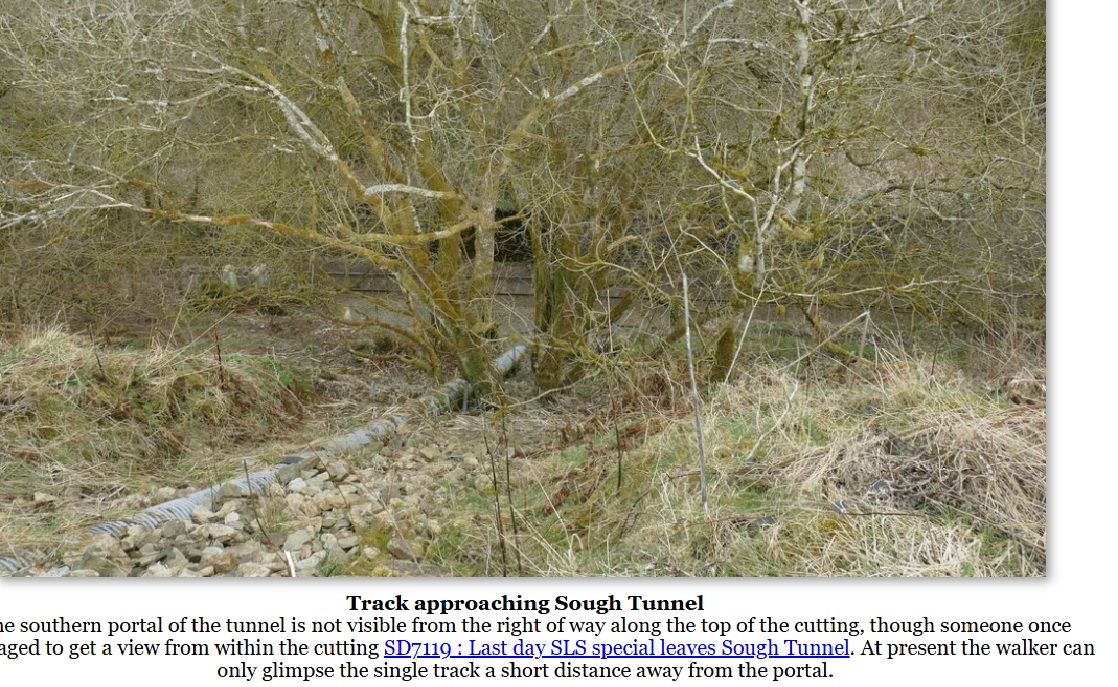
The tunnel (pronounced 'suff' not 'sow')
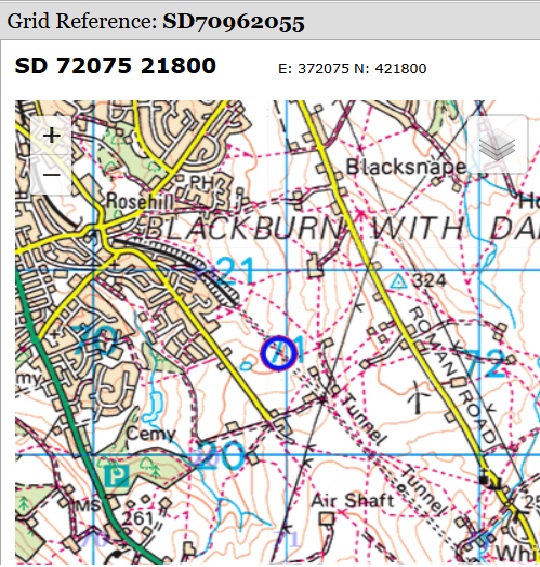 was opened in 1848 by the Blackburn, Darwen and Bolton Railway, and was originally called Cranberry Moss Tunnel as shown on the 1850 OS map. The engineer was Terence Flanagan. The tunnel
is set out on a straight line, is 1850m long, and beneath the highest part of the moor is 260ft
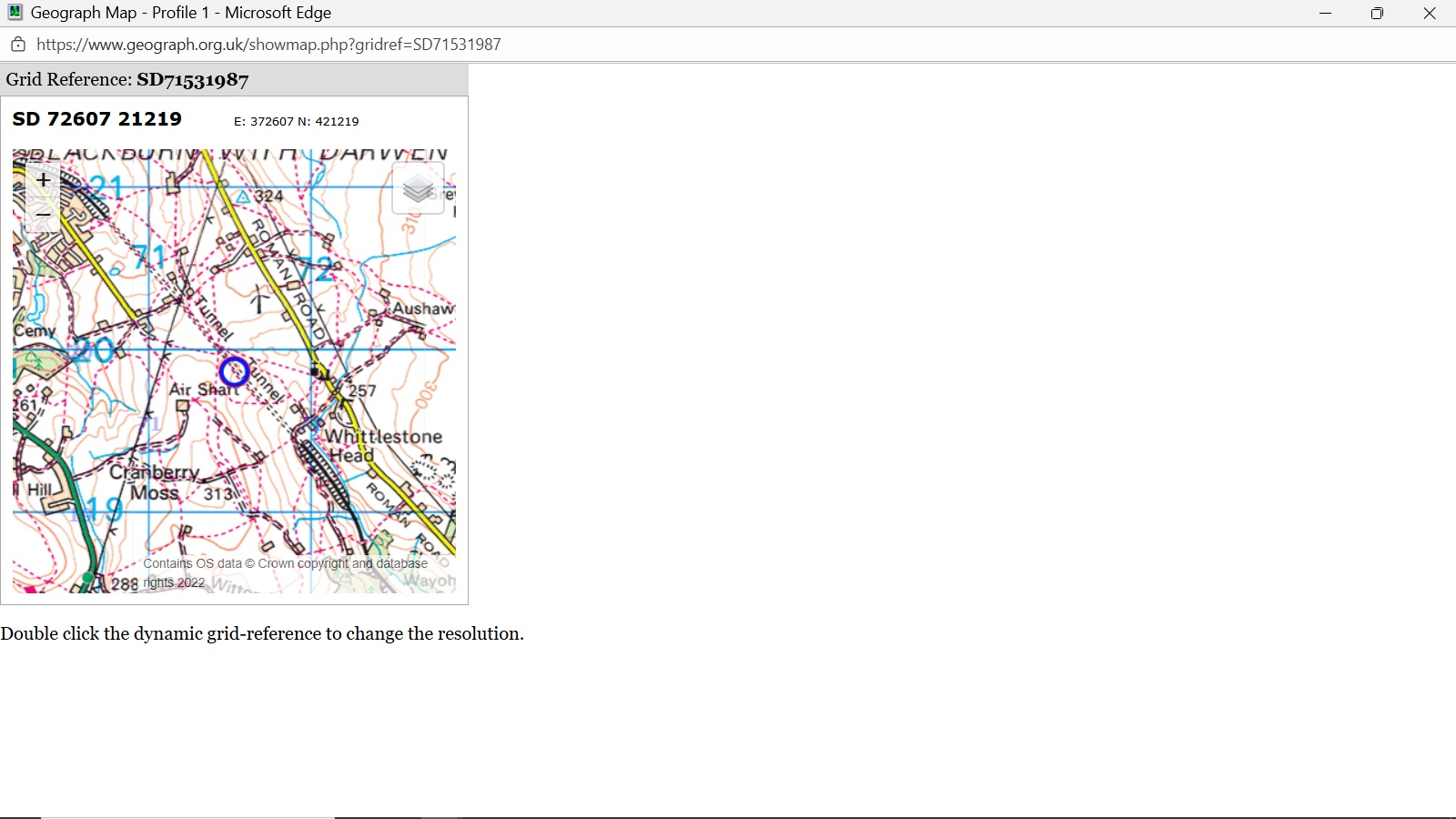
(79m) below ground. Click on map for slighly larger image.
was opened in 1848 by the Blackburn, Darwen and Bolton Railway, and was originally called Cranberry Moss Tunnel as shown on the 1850 OS map. The engineer was Terence Flanagan. The tunnel
is set out on a straight line, is 1850m long, and beneath the highest part of the moor is 260ft
(79m) below ground. Click on map for slighly larger image.
Two of the original eleven construction shafts have been retained as ventilation shafts, while the others can be identified by the adjacent spoil heaps that are still visibleThe line through the tunnel was originally twin track but has been singled in recent decades.
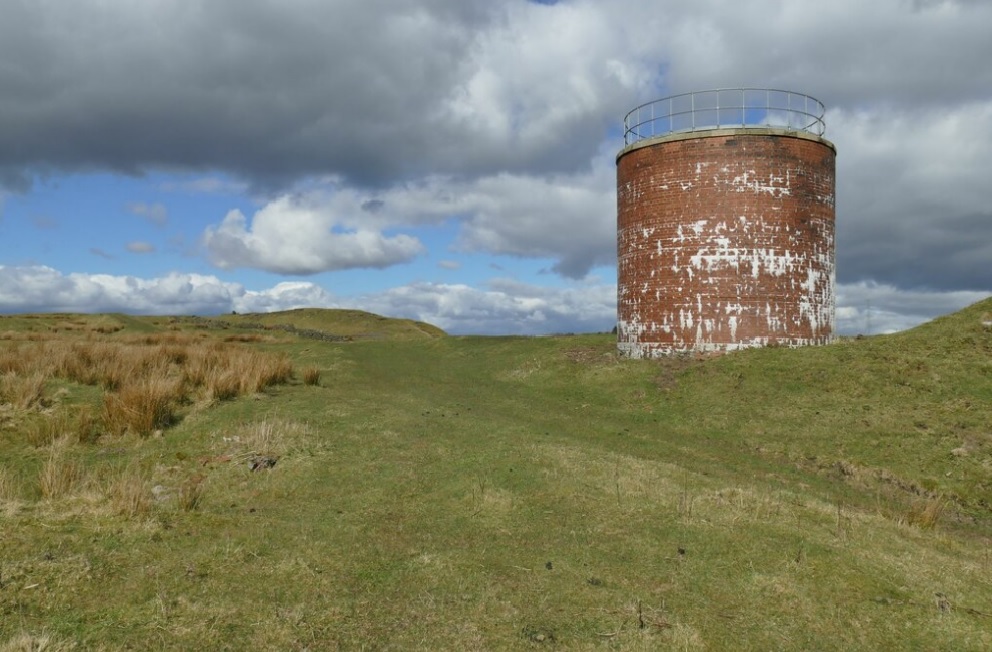
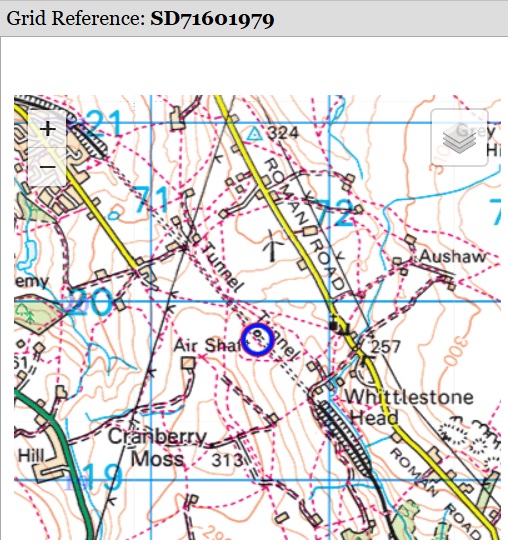 and the only one that has close public access. A modern safety railing dates from a 2020 contract in which 'Network Rail used a specialist helicopter team to transport five tonnes of bricks and materials to build a new 2.6-metre diameter metallic grille on top of the shafts.'
Click on map for slighly larger image.
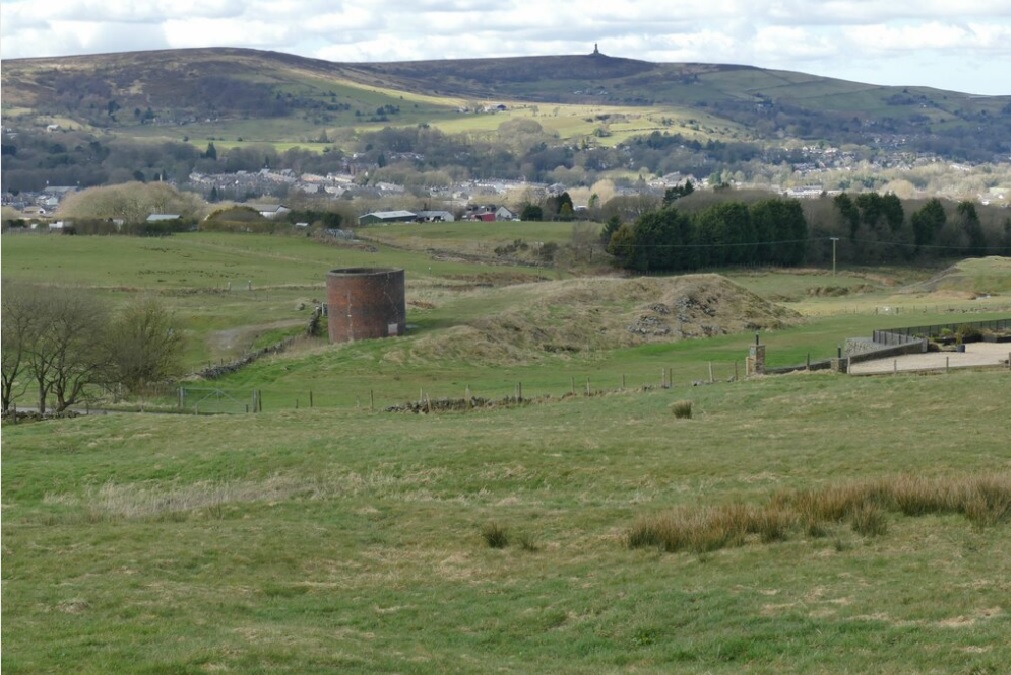
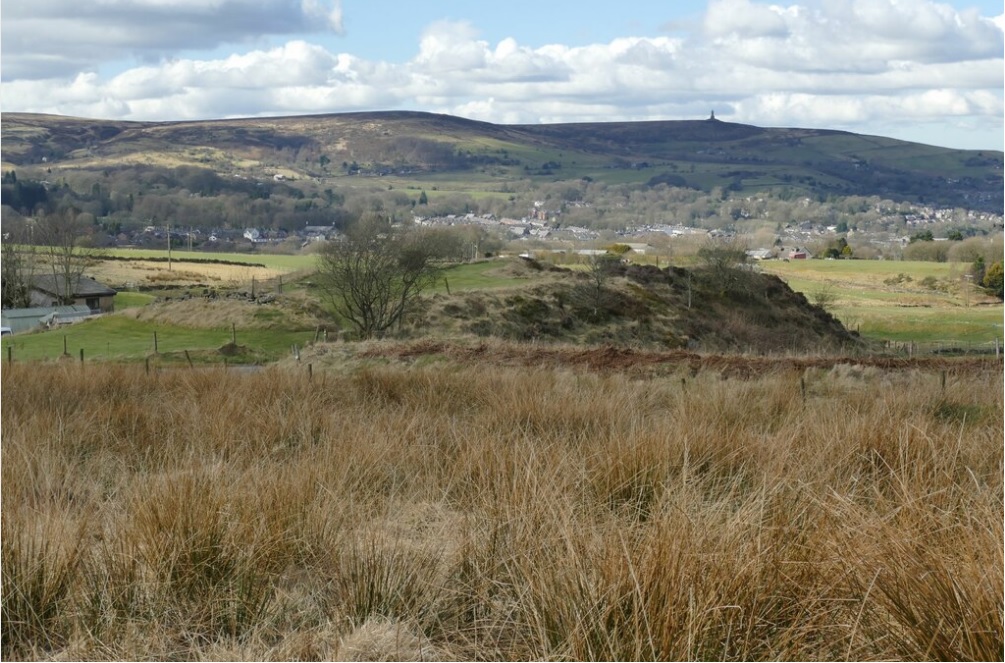
One of two remaining
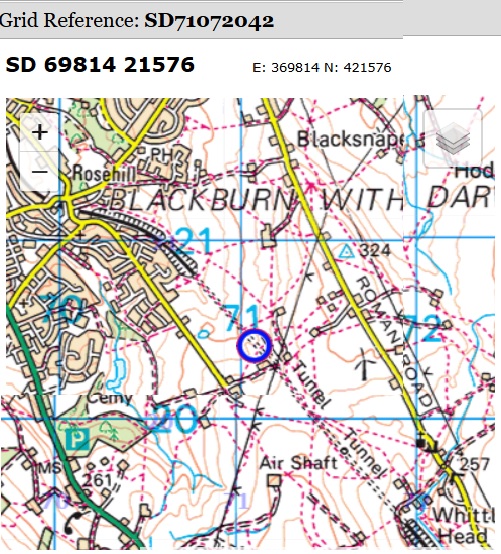 shafts along the line of the tunnel, along with its
spoil heap. In the distance is Darwen Tower.
shafts along the line of the tunnel, along with its
spoil heap. In the distance is Darwen Tower.
The placename
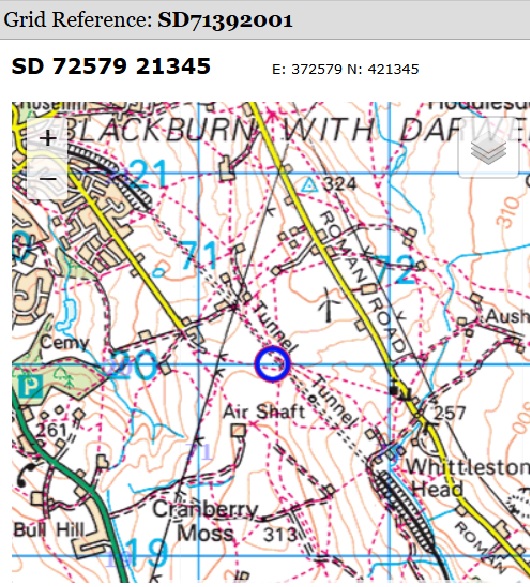 is shown on the 1911 OS map, although there
was no building shown. The 'nook' probably refers to the col or slack at the top of a shallow
clough above Grimehills.
is shown on the 1911 OS map, although there
was no building shown. The 'nook' probably refers to the col or slack at the top of a shallow
clough above Grimehills.
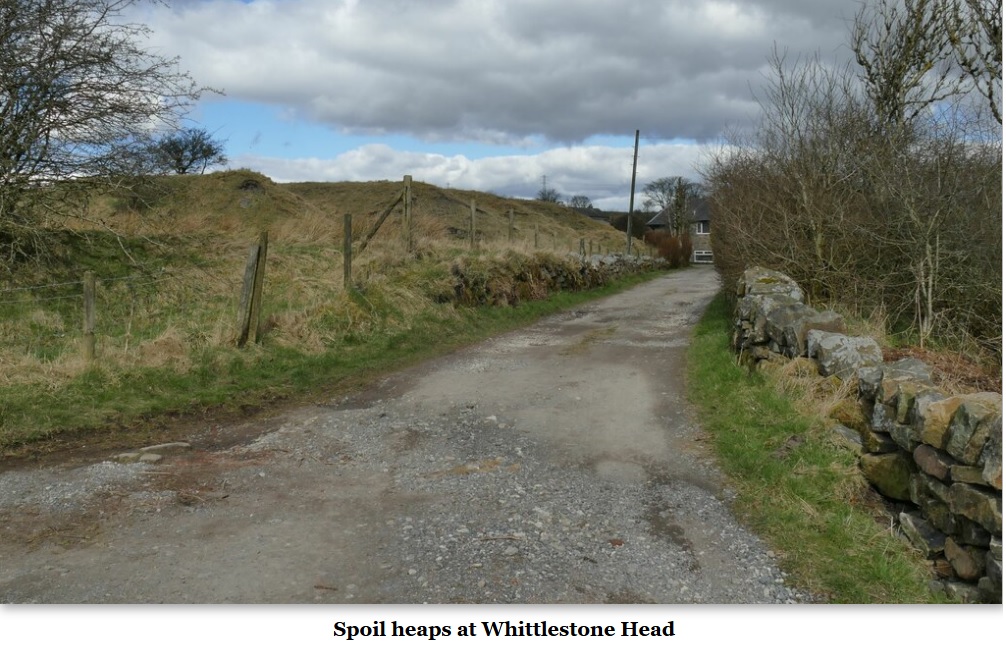
This is just a short distance
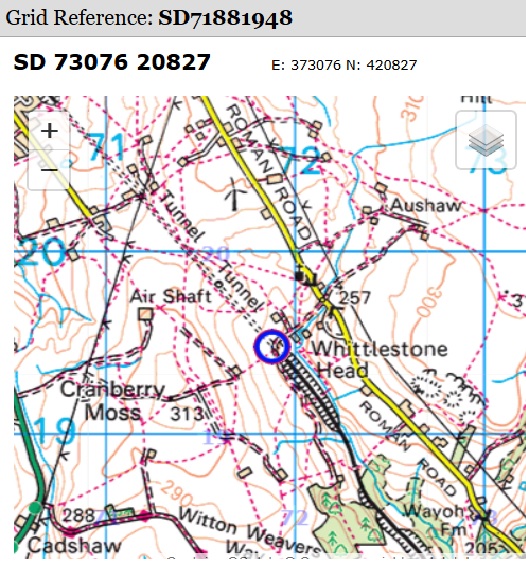 into the southern end of the tunnel, so the spoil may be from the approach cutting as well as the tunnel itself.
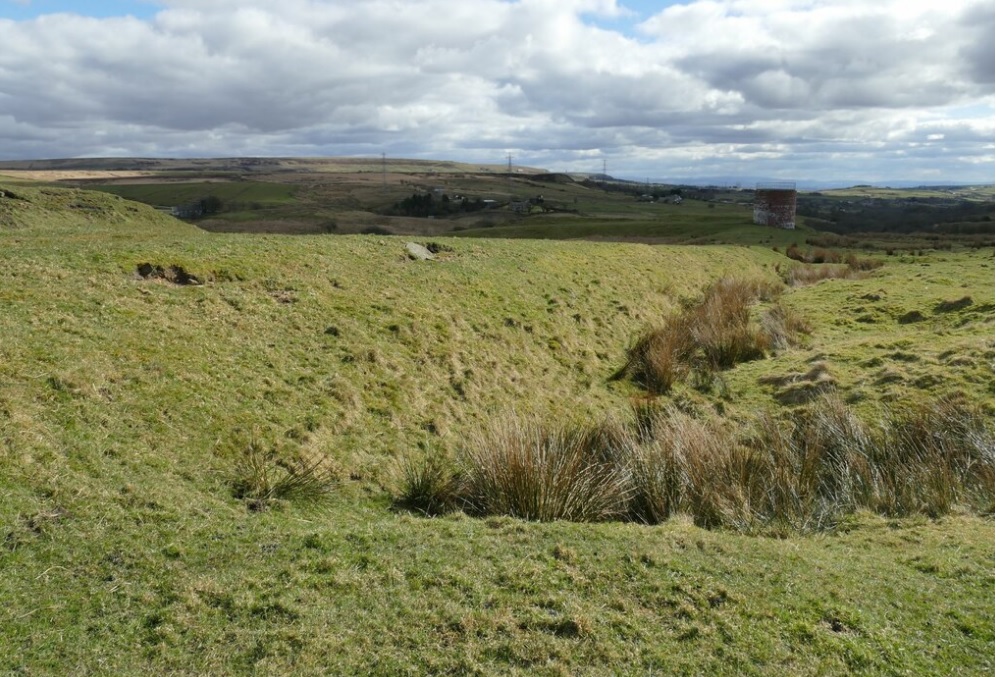
Evidence of the construction of Sough Tunnel beneath.
 Although it may look
level in this view, the top of the embankment rises 6m in its 150m length (a gradient of 1:25).
Although it may look
level in this view, the top of the embankment rises 6m in its 150m length (a gradient of 1:25).
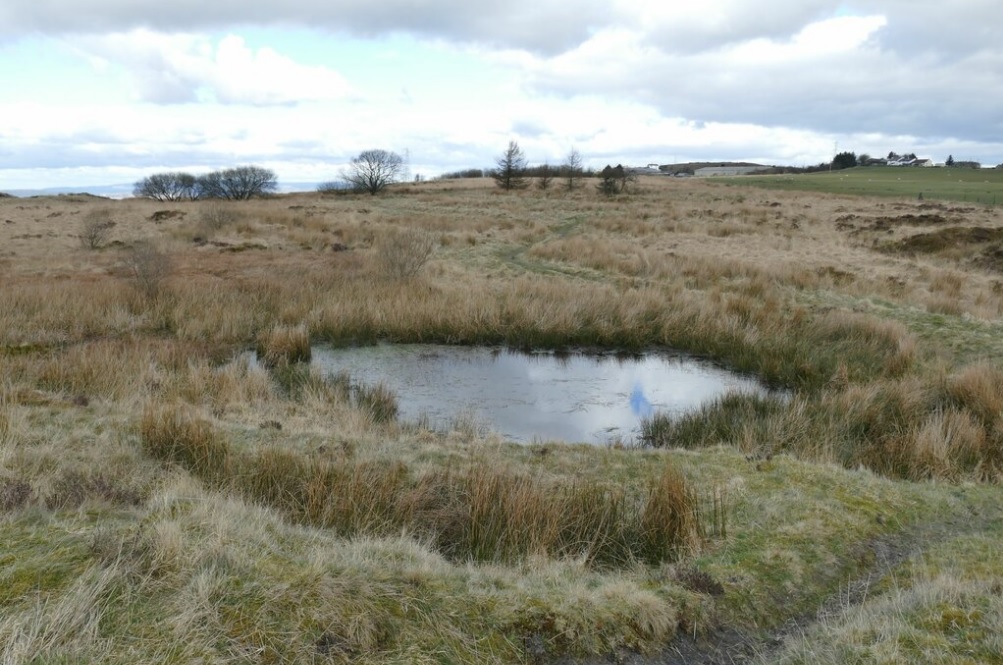
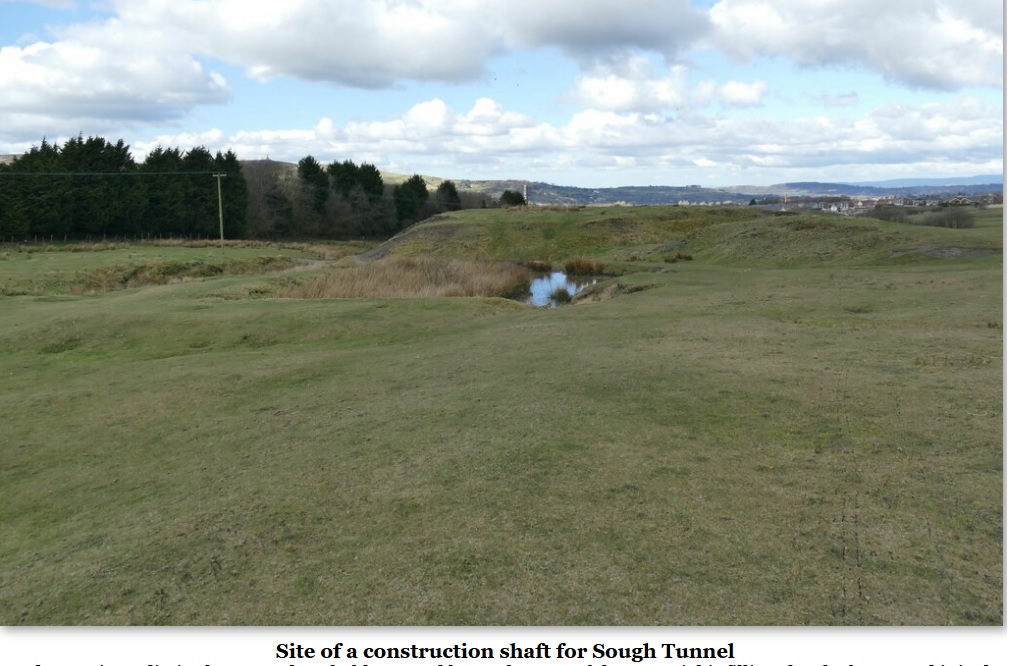
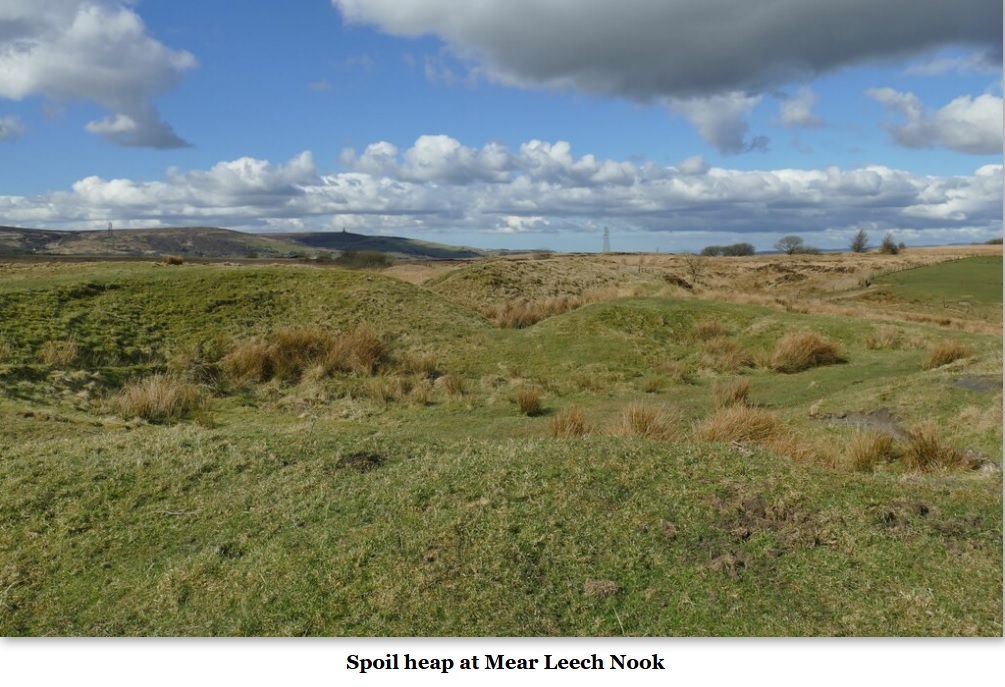
The pond occupies a dip in the ground probably caused by settlement of the material infilling the shaft, one of eleven used to construct the tunnel in the 1840s.
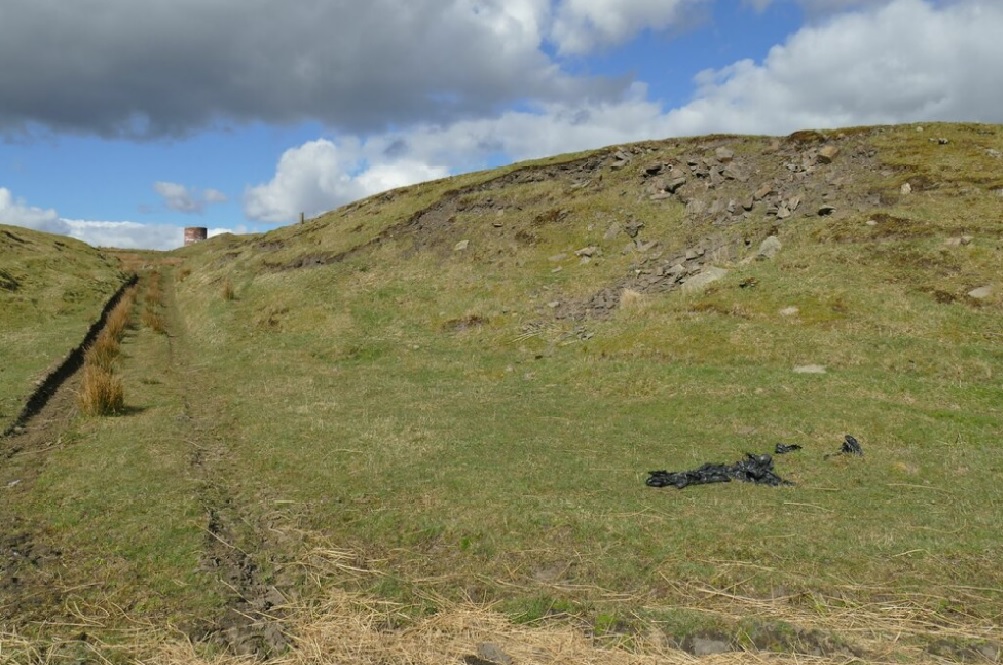
The spoil from the southern ventilation shaft SD7119 :
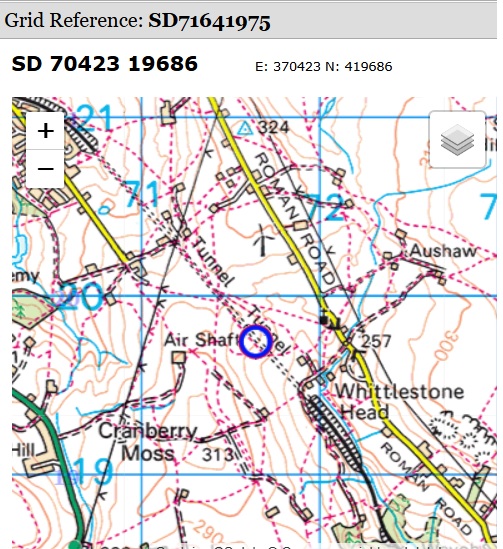 Southern ventilation
shaft for Sough Tunnel contains mainly shale, not surprisingly as this comprises much of the Coal
Measures (there were many small coal pits nearby in earlier times).
Southern ventilation
shaft for Sough Tunnel contains mainly shale, not surprisingly as this comprises much of the Coal
Measures (there were many small coal pits nearby in earlier times).
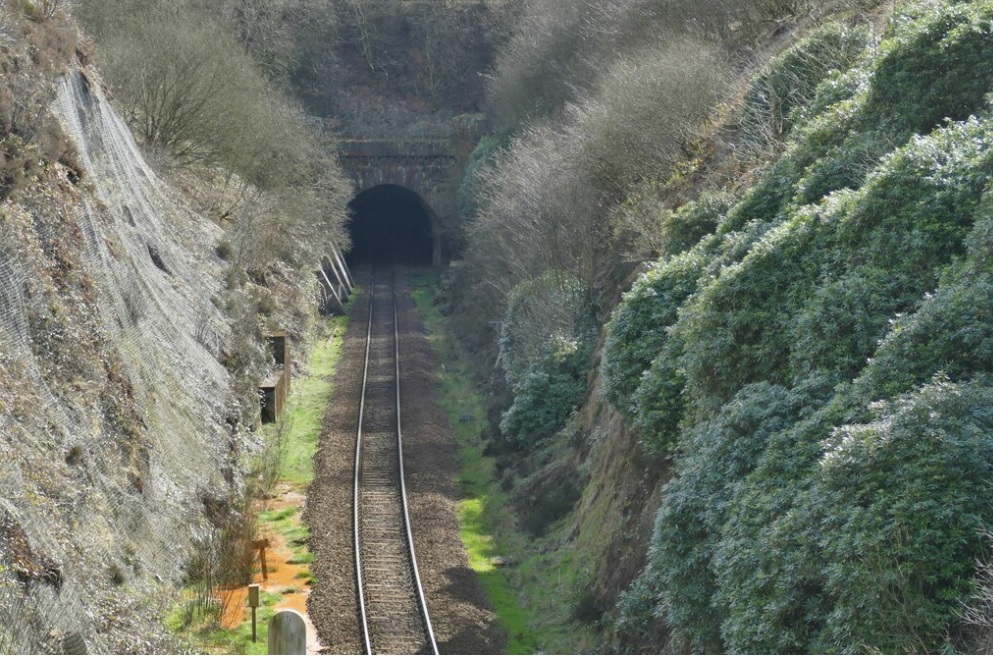
The portal is listed grade II (list entry 1362163).
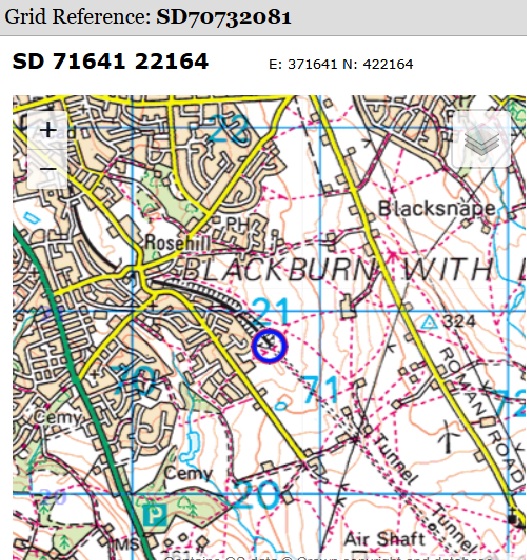 The corresponding south portal is not as clearly visible as this one is from a nearby footbridge. It was still a twin-track line in1968. The single track restricts the passenger service to two trains an hour in
each direction.
The corresponding south portal is not as clearly visible as this one is from a nearby footbridge. It was still a twin-track line in1968. The single track restricts the passenger service to two trains an hour in
each direction.
The tunnel's design was not straight and was uphill from Darwen to Entwistle, making it difficult to work on the railway lines in the tunnel due to the smoke from the engines. However, the introduction of diesel locomotives in the 1960s helped solve the problem of smoke and trapped staff. The Sough Tunnel remains a significant historical site, with its shaft turrets still visible today, and it has been repaired from the air to maintain its safety and reliability for trains.
The Blackburn, Darwen and Bolton Railway
An Act of Parliament was obtained in 1845, authorising the construction of a line called The Blackburn, Darwen and Bolton Railway, and the first portion of this, from Blackburn to Sough in Darwen was opened on the 3rd of August, 1847. For the next ten months passengers from Blackburn for Bolton and Manchester had to leave the train at Sough station, and proceed by Birch's stage-coach to Bolton; but Sough Tunnel was in the course of construction, and the complete line was opened on June 12th, 1848.When I walked around this area I noticed how the railway skirted Top o'th'Meadow's farmland inside a deep cutting before disappearing into the southern entrance of the tunnel. Top o'th'Meadow is still there but Bannister House is long gone, only identifiable via old maps of the area.
Building the Tunnel
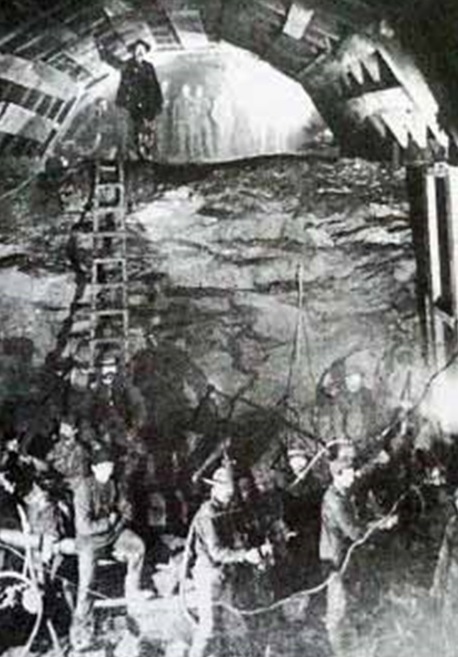 The route chosen for the tunnel was under Cranberry Moss, from Whittlestone Head to Sough Village, a distance of some 2015 yards. Cranberry Moss was a badly drained wasteland rising to over 1000 feet above sea level and then, as now, riddled with old colliery workings.
The first problem the contractor (John Evans Senior of Oldham) encountered was the recruitment of specialist tunnellers who had to be enticed away from coal mines in Yorkshire, Wigan and Wales with the promise of high wages. The unskilled part of the work force was mainly of Irish descent and eventually some 2,000 men were working on the tunnel project. The plan was to sink a number of shafts in a line across the Moss with depths varying from 40ft to 260ft deep and then drive headings between them to make a continuous tunnel.
By February 1846 the Engineer-in-Chief, Charles Vignoles, was able to report to the directors of the Blackburn, Darwen and Bolton Railway Company that the contractor, Mr Evans, had about 1500 men employed, opening up the ground in twelve faces up to Darwen. On the line of the Tunnel, eleven shafts are in various states of progression, and some of the Tunnel Drifts have already met.
With candles, hand drills and gunpowder, for over 2 years the miners cut into sandstone, shale, clay, and occasional coal seams at a gradient of 1 in 74 until the tunnel was over a mile in length and lined with stone and brick. The height varied between 22ft. and 24ft. and the width was 24ft. Even now on a dry summer's day the tunnel is damp and has a foul earthy smell. The walls run with water and the cold is penetrating. The only relief the miners would have had was from large quantities of raw whiskey said to have been made in illicit stills concealed in the various mine workings.
The Navvies
Most of the navvies would live in makeshift huts up on Cranberry Moss, in groups around the top of the shafts they were working on, or at the tunnel ends. The Parliamentary Select Committee Enquiry on Railway Labourers in 1846 described navvies' housing as basic -- wood or turf huts with a mutual gable with a fireplace either side and providing accommodation for maybe 20-30 people. The beds would be arranged in tiers and often had multiple occupants; they were described as 'wet and unhealthy' and 'insalubrious and fetid'The construction workers and their families were camped in the fields around the hamlet for over two years. Law and order was practically non-existent and living on this bleak hillside in shelters open to the elements made for a hard life. As might be expected, with over 2000 men, plus women and children, there were many social problems in this quiet back-water
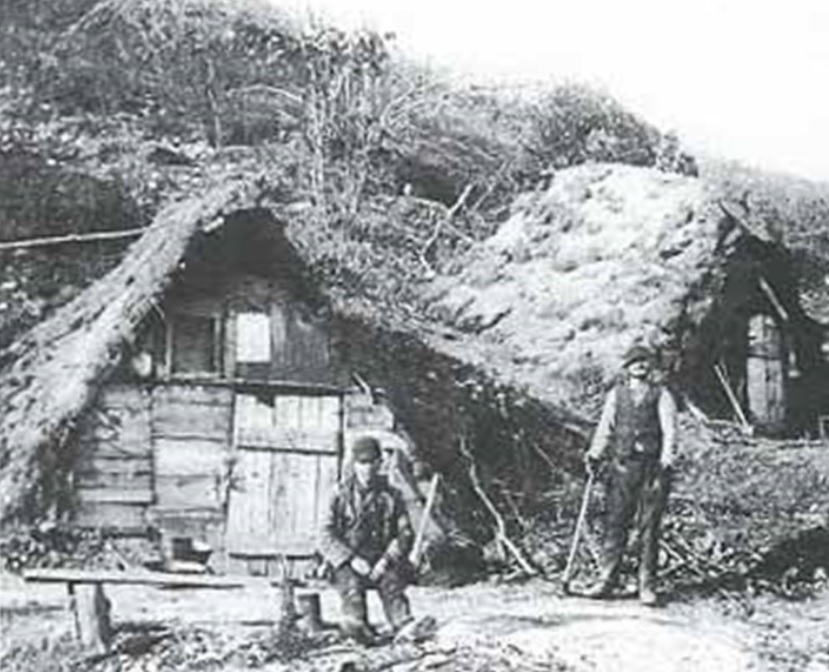 Labouring six days a week for a gold sovereign, working in shifts, navvies might move as much as 22 cubic yards of earth per shift. Women and children often worked alongside their menfolk without pay. Gambling and fighting seemed to be their main pastimes, clog fighting almost naked for a five pound wager was common practice. One Irishman's favourite trick was to bet anyone he could hang by a rope tied round his neck from a ceiling beam; the price of this wager was five pounds. He had performed the trick many times, but sadly in 1847 at Whittlestone Head Tavern, he lost his bet.
Many of the local people took a dim view of this behaviour and wanted Mr Evans, the contract foreman to provide better security - but to no avail. Ale could be had at any time at Greenhalgh's Inn, Whittlestone Head or at the Railway Tavern, a small farm just a few yards away. Drunken brawls were an all too common occurrence.
Dangerous Work
A most macabre incident is recorded during the Sough Tunnel construction. Two Turton men, father and son, were employed to fill the unwanted shaft No 5 from a wooden stage spread across the 10ft diameter surface opening. An overnight storm had washed out much of the loose earth from underneath where the platform rested on the edge of the shaft. When both men stepped on to the delicately poised planking it tilted sharply downwards plunging them to their deaths 100ft below. An avalanche of stony rubble cascading down the partly filled cavity effectively entombed them. Attempts to retrieve their bodies, as well as that of a labourer who fell into shaft No 9, were abandoned and some weeks later the openings were completely closed.
Shaft No 6, rising midway along the tunnel, was the deepest of them all and it claimed twelve years old Billy Godbhere as a victim. His job was to run to the smithy with picks that the men had sent up for re-sharpening. Bored with waiting and watching the hopper as it came up the shaft laden with spoil, he gave the hopper a playful swing. It rebounded and knocked the hapless child over the brink of the 260ft shaft.
The Tunnel in Use
The first train came through the tunnel to Bolton on Monday 12 June 1848 at 7.05 a.m. It was a regular service train of eight carriages, packed to capacity, which completed the journey from Blackburn to Bolton in thirty eight minutes.
The company's timetable listed six trains on weekdays to Bolton and Salford (for Manchester) and the same in the reverse direction. There were three trains each way on Sundays. Initially passengers were conveyed in three classes of carriage, as under the Railways Act of 1844 third class passengers had to be conveyed and accommodated in closed compartments with seats at a charge not exceeding one penny per mile. All railway companies were legally bound to provide these facilities on at least one train per day known as a 'Parliamentary'. In this way rail travel became available to all but the poorest section of society. The effect the coming of the railway had on Entwistle was enormous. I often wonder what my great great grandmother thought about it all!
My Family and Sough Tunnel
During my own family tree research and visits to the Entwistle area I have become aware of how close to the Sough Tunnel my family lived. My great grandfather, Edmund Entwisle, was born in 1839 at Bannister House (or Penny Shore) and lived there until his marriage in 1859. After just a few years of married life in the Sough/Cranberry Fold area of Darwen (including the birth of my grandfather in 1867) the young family moved back across the moor to Top o'th'Meadow Farm, also at Whittlestone Head, farming 30 acres.
Construction of the tunnel began when Edmund, my great grandfather, was aged 7. At that time his parents, James and Ann Entwisle, were living with their 4 children at Bannister House while the tunnellers worked about 100 metres away.
I was particularly interested to read Charles Vignoles' report, presented to the railway company in February 1846. That was the month in which my great great grandmother, Ann Entwisle was admitted to Bolton Workhouse, described as 'not able-bodied, insane'. She was discharged by order of the surgeon on 11 March 1846 and then for about 3 weeks she was presumably back at home at Bannister House with her family. She was re-admitted as 'insane' to the Bolton Workhouse then discharged from there on 7 April 1846 to the District County Lunatic Asylum, Lancaster. She stayed there until 1853 before returning to Entwistle and continuing her family life, giving birth to 4 more children.
More of her story was told in the September 2008 issue of Twissle Times (see EFHA members 'archive) and also on our own family website www.cowen-ent.co.uk
Ann obviously did have ongoing mental health problems but I have often wondered what effect the huge changes in her home environment must have had on her stability. Had there been some unsavoury incident affecting this 30 years old woman or her four young children? I've also wondered what she thought when she returned home in 1853 to see 12 trains passing her home daily as well as the new tunnel and the huge viaduct at Bradshaw just a little further south. Maybe she travelled home from Lancaster by train? Probably a much easier journey than when she was sent there in 1846!
I've also speculated whether my great great grandfather James Entwisle worked on the tunnel himself. He was described in the censuses as a quarry labourer. When construction began on the Blackburn, Darwen and Bolton Railway tunnel at Whittlestone Head in 1846 there were many other railway projects under way around Britain. In Lancashire and other parts of the north farmers complained that most of their men had gone to the railways but even so the contractors needed more.
end of file
