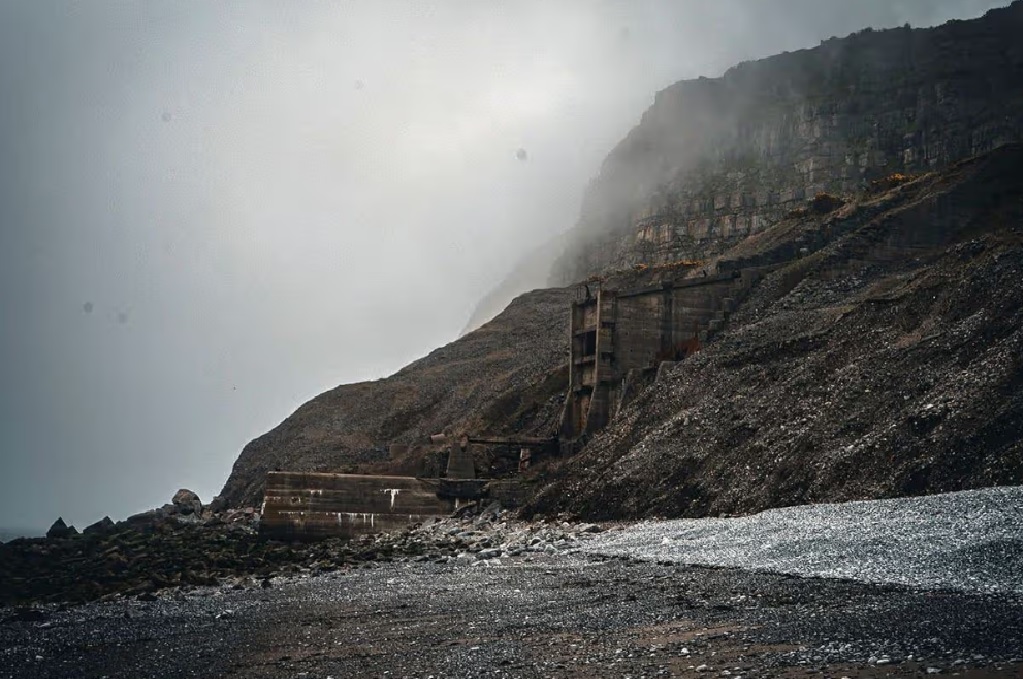
Viewed from passing ships, the austere angular structures on Anglesey’s southeast coast look curiously out of place. Spilling down towards the shoreline beneath towering limestone cliffs, they’ve been compared to geometric Aztec architecture or the ziggurat pyramids of ancient Mesopotamia.
With a little imagination, they could be part of a military stronghold, possibly even a villain’s lair. The reality is even more impressive: this, according to Facebook’s North Wales Nostalgia site, was part of a landscape shaped by “ordinary men doing extraordinary things”.
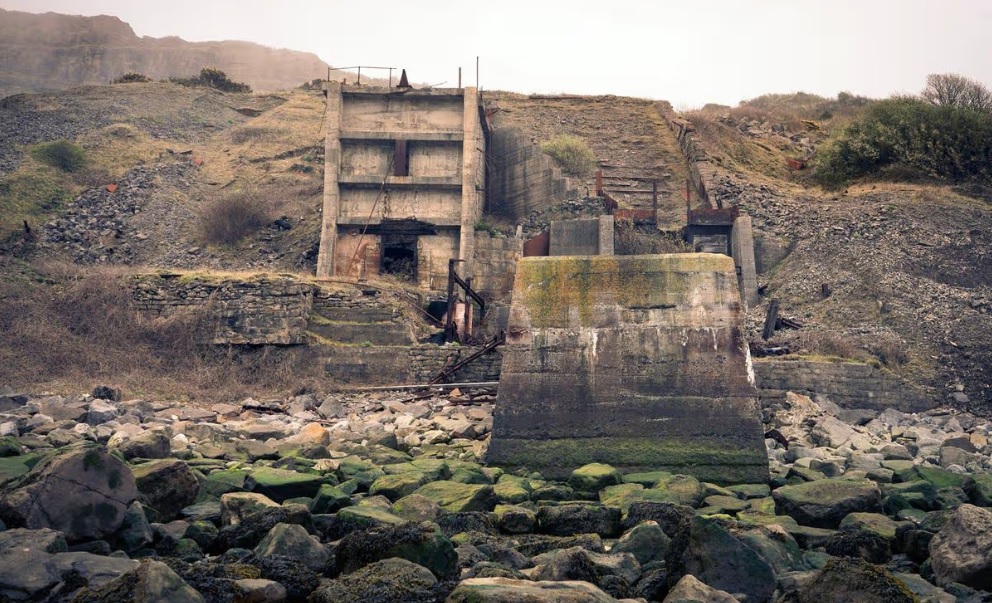
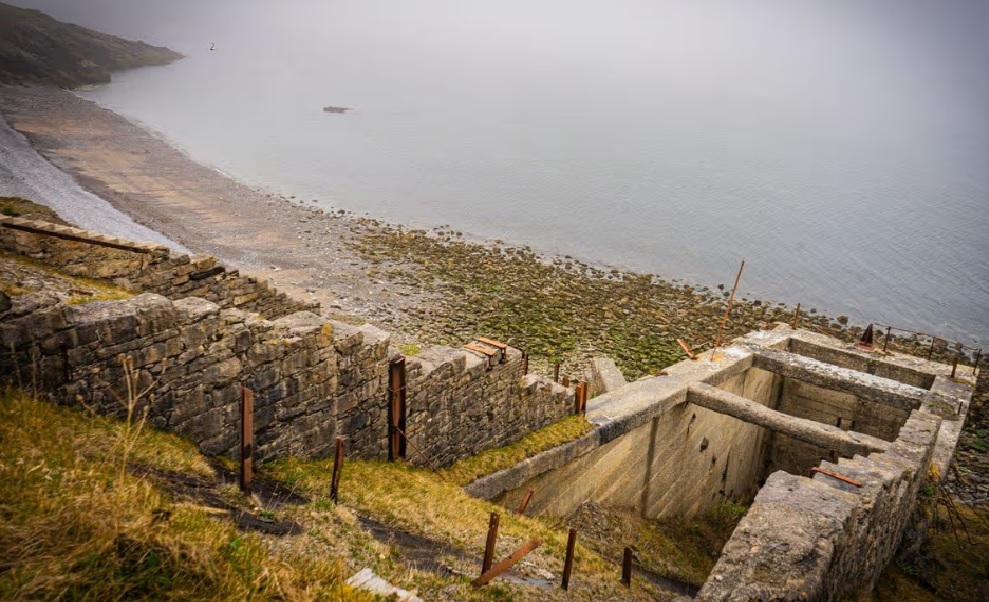
Other than two concrete sections of a giant three-part crusher house tumbling down the slope, little now remains of a quarry that once echoed to the sound of hammers and gunpowder.
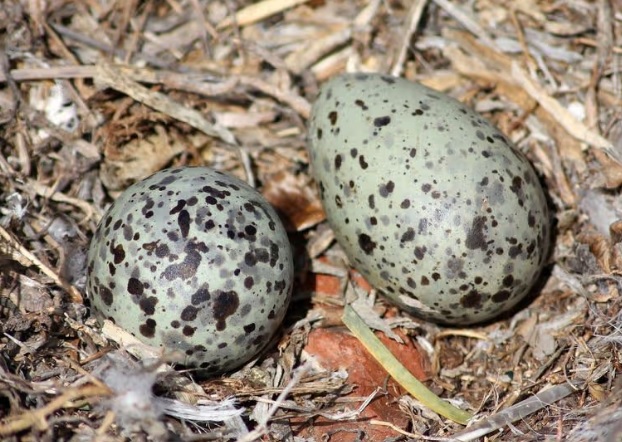
The work here was gruelling and often dangerous, the men donning iron-hobbed boots to commute to work before returning home with seagull eggs for family baking. Injuries or worse were not uncommon. Nearby runs a scenic section of the Anglesey coastal path, from which runs a footpath down to Carreg Onnen quarry, later renamed Tan Dinas. It is, said visitor Carwyn Vaughan, “truly a hidden gem on Anglesey”.
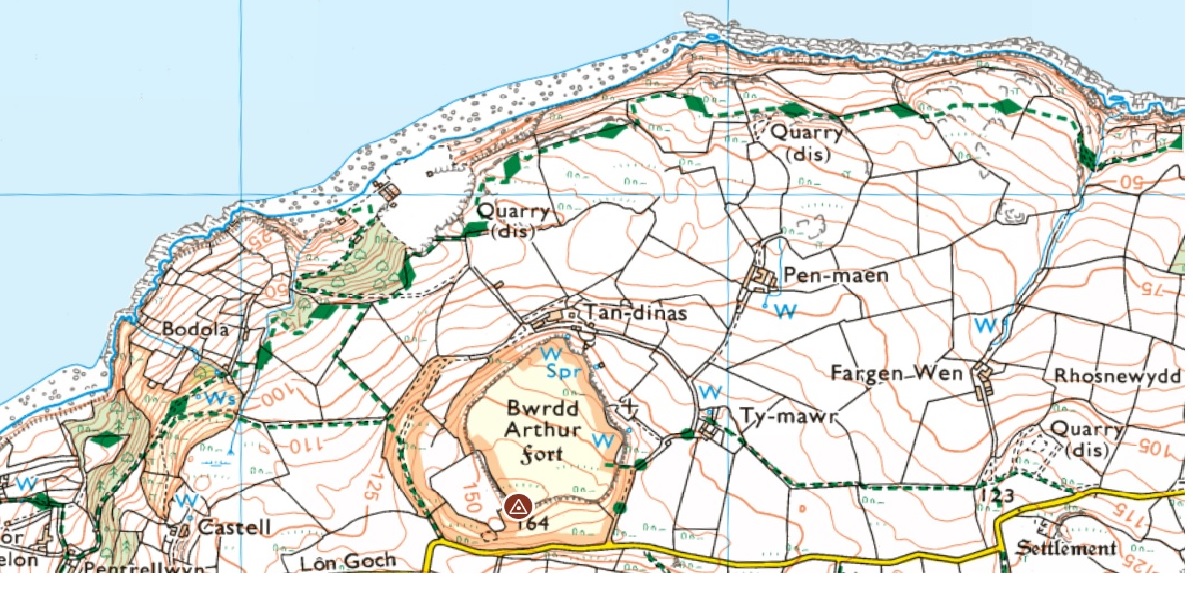
Carreg Onnen/Tan Dinas was part of a group of quarries that shaped this part of Anglesey. Several were centred on Penmon further south. These included Dinmor which supplied stone for the two Menai bridges; and Penmon Park, whose polishable stone – known as “Anglesey marble” – was a key material for Liverpool’s iconic Liver Building. Carreg Onnen’s output was less auspicious but just as important, certainly in its later years. As Tan Dinas, the quarry's limestone was used mainly for construction aggregate and chippings, while on-site concrete works operated on an industrial scale to support post-war reconstruction in heavily bombed cities like Liverpool and Manchester.
The site, 2.5km from Llanddona, was first worked in the late 19th century. Before inclines or tracks were installed, massive blocks of stone had to be hauled in carts across the rugged coastline.
Quarrymen from Llanddona, Pentraeth and Llangoed broke high-purity limestone using sledgehammers, hand drills, crowbars. Black powder explosives blasted limestone from cliff faces. By 1912, the quarry had been stripped of its easier-access stone and was abandoned soon after. Immediately after World War II, with better technology available, the site was revived by Cawood, Wharton & Co. It was renamed Pen Dinas.
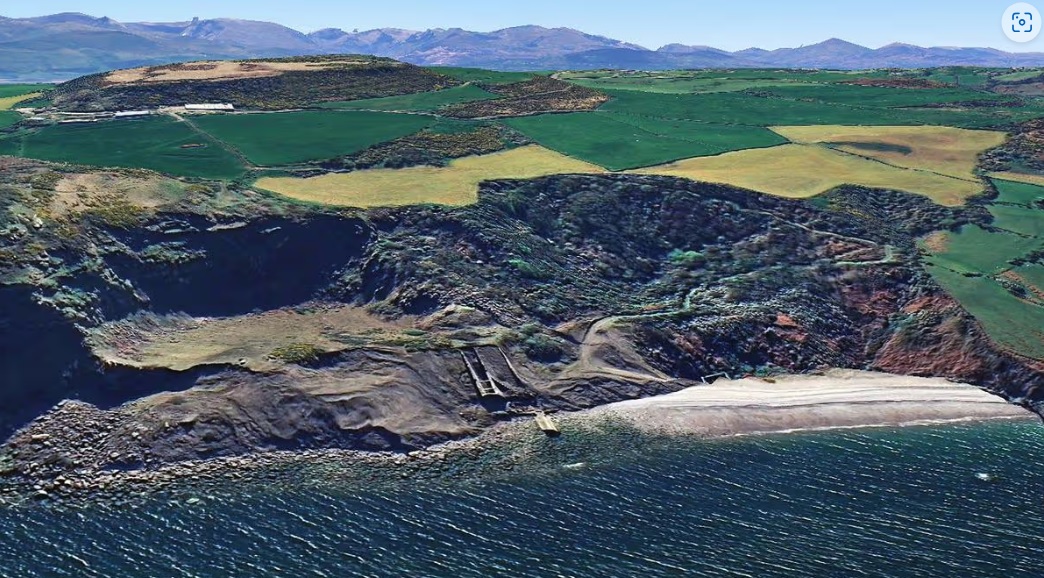
The company built a 2ft narrow gauge railway, installed an uphaul incline and constructed a three-section concrete crusher house to powder quarried limestone for lime burning. Also erected was a wooden loading jetty on the foreshore with an automated conveyor belt system to feed stone directly onto sea-bound transport barges. Until it was dismantled in the 1960s, the deteriorating jetty became renowned as one of the island’s best fishing spots. For many sea anglers, the Tan Dinas foreshore still is. Constable's daring rescue Not long after the quarry resumed operations, it was hitting the headlines. In May 1951, 11-year-old John Batt from Red Wharf Bay was collecting seagull eggs when he became stranded midway up 300ft quarry cliffs eaten into the hillside. Three men tried and failed to mount a rescue. Stepping forward was Constable John Emlyn Jones of Llangoed. Two young men from the same village took the strain while he was lowered down the precipice on a rope. The Caernarvon & Denbigh Herald reported it was a “most dangerous and daring operation”. It was also flawed: the rope was too short. Another had to be sourced while PC Jones dangled.
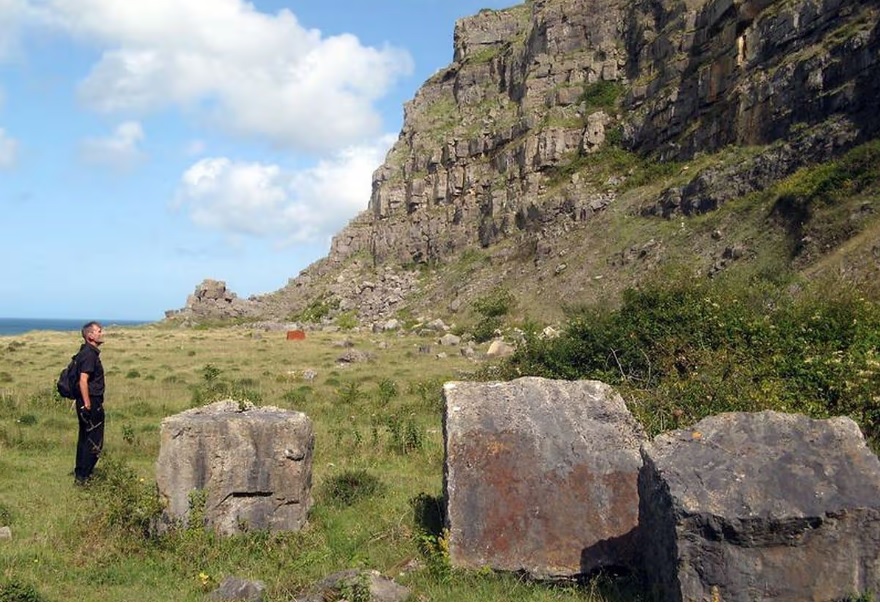
“The perilous task of descending 150ft to the bottom of this most dangerous spot took PC Jones one-and-a-half hours. But he succeeded and the boy was none the worse for his exciting experience.” Constable Jones was reluctant speak about his “most daring and brave exploit”. Nevertheless, he was later awarded the British Empire Medal for heroism. Fascinating place for industrial explorers The quarry’s cliffs are its most notable attribute. Geologists have identified 14 sedimentary cycles in its limestone rocks, making it comparable in age and structure to the Dee Valley’s famous Eglwyseg escarpment, Denbighshire. When winter storms blow in and gales howls against the rock, it can be a forbidding place. Commercial quarrying at the site ceased in 1959. Machinery, tipper wagons and the narrow-gauge rail tracks were systematically stripped out. Today, nature has reclaimed much of the area.
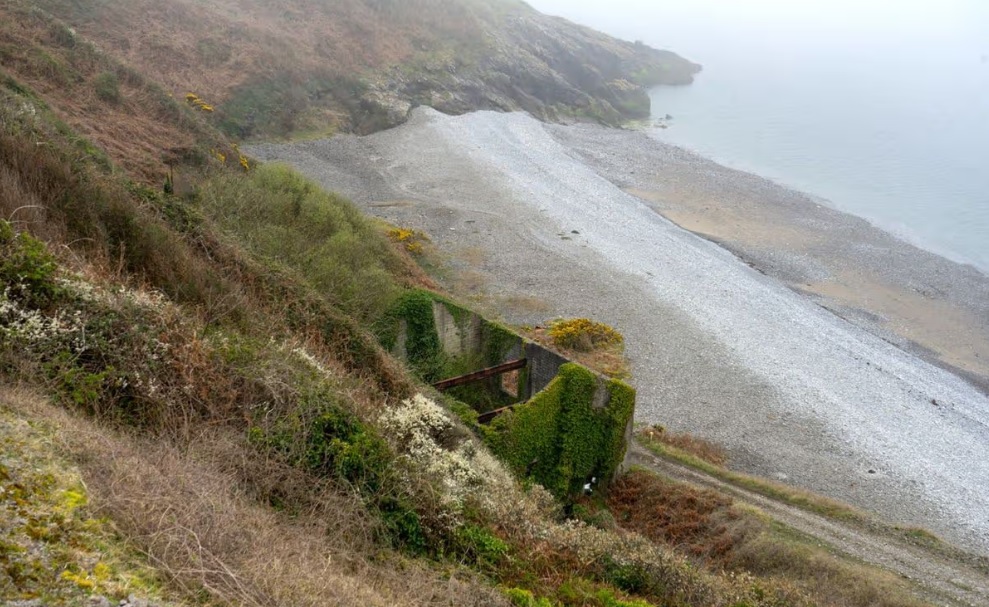
Some prominent ruins remain, including the uphaul incline and two-thirds of the concrete crusher house, whose stark, windowless frames resemble brutalist wartime bunkers. It was here where large limestone blocks were tipped down the slope for mechanical crushing. The resulting powder or chippings were stored in internal hoppers before being funnelled down to the shore and its jetty. Scattered across the quarry floor and beach are rusting fragments of past activity frozen in time – iron wheel-sets from the railway, heavy rollers from the conveyor belt and corroded sections of grading machinery for chippings.
A rare piece of industrial archaeology is a large, horizontal water-cooled diesel engine which drove the conveyor belts, now heavily weathered. Eerily, several giant quarried limestone cubes still litter the foreshore. The old quarry is now protected as a Site of Special Scientific Interest due to its limestone plants and rare geological formations. Being near the coastal path, it’s relatively accessible, though parking nearby can be an issue. Its history and location makes the beach a fascinating stop for industrial explorers. North Wales Nostalgia concluded: “Today it’s peaceful and protected for its geology, but every ledge you see was cut by hand.”
©Andrew Forgrave Countryside and tourism editor North Wales Live
